
Ausbildung
What is Ausbildung
Ausbildung is a German word which means “Vocational Training (or) Apprenticeship”. It is a structured vocational training program that combines classroom based theoretical education with on-the-job training to gain hands-on experience. Unlike traditional educational format which focuses more on texts and tests, Ausbildung covers both the academic side and the professional side which results in preparing the future professionals.
Ausbildung has two types – Schulische Ausbildung and Duale Ausbildung.
1. Schulische Ausbildung
The word “Schule” in German means school. This type of Ausbildung prefers more of academics than professions.
2. Duale Ausbildung
Duale/Dual Ausbildung tends to be more work-based than academics. The classes would be held in Berufsschule (Ber-uf-ssch-ule), German vocational education school.
The individuals who enrolled in this program are called “Auszubildende” or apprentices. The duration of the program may vary between (2-3.5) years depending upon the course selection. The auszubildendes are required to split their schedule between working at the job location and attending theoretical sessions at the vocation-based education schools in Germany.
Benefits of Ausbildung in Germany
Learn & Earn
Ausbildung program allows students to learn and labour in the same field which results in independence and responsibility.
Structured Program
The program is organized in such a way that the individual dedicates time to study and work simultaneously without compromising one another.
Career Advancement
Throughout training and education, the student could make progress with their respective fields.
Acknowledged Certification
The “Course Completion” certificate would be awarded, and this would be accepted in Germany and other countries for job opportunities.
Pathway from Education to Employment
The program acts as a mid-way between Profession and Education so that, post completion of the program, the student can decide based upon their need..
Personal-cum-Professional Development
The program develops both professional adaptability (such as workplace dynamics, cultural sensitivity etc.) and personality development (communication, problem solving etc.) in unison.
Becoming PR
Ausbildung would become the first step for the person who decides to stay via Permanent Residence (PR) in Germany.
Integration with European Culture
Gain a deep understanding of European traditions and values while building meaningful connections in a multicultural environment.
Better Quality of Life
Enjoy access to world-class healthcare, education, and a balanced work-life experience that enhances personal and professional growth.
Eligibility Criteria for Ausbildung in Germany
- Individual who completed 12th are eligible. However, degree holders too can apply
- 18-30 years of age
- German language certification
Required Documents
- Transfer Certificate
- German Certifications B1/B2 are required as per the need of the course
- A letter which explains the motivation to apply the program. It also requires the justification about one’s suitability.
- A letter which explains the motivation to apply the program. It also requires the justification about one’s suitability.
- Personal CV which explains the education and employment (if employed) history.
- Application Form
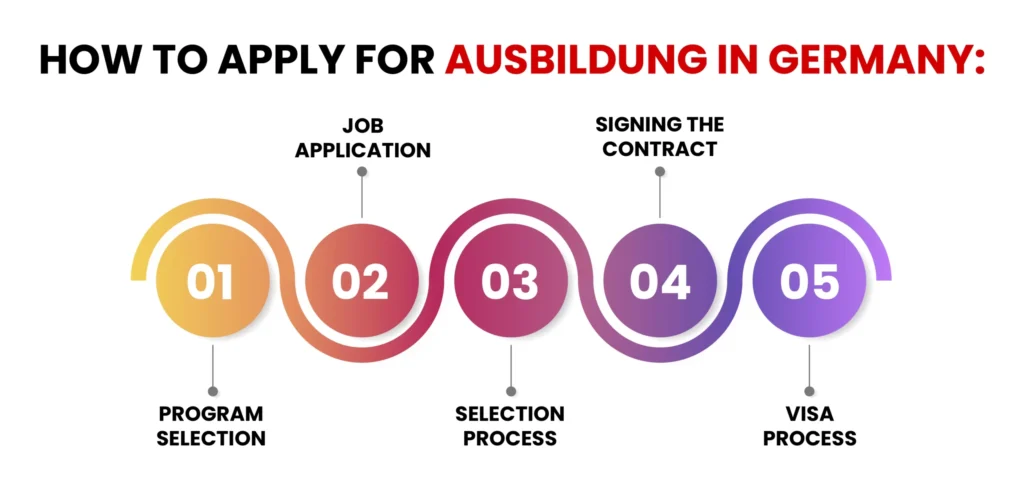
1. Stream Selection
One must finalize the course which meets the interests and aspirations via proper R&D.
2. Applying to the Company
After finalizing, one can either directly apply to the company or via the Federal Employment Agency (FEA) of Germany. Submit the form along with the prerequisites mentioned since the requirements of each course in Ausbildung is subjective.
3. Selection Process
If the application form gets shortlisted, the applicant shall be called for an interview via in-person or in-digital. In some companies, interviews may not be preferred.
4. Contract Signing
If the applicant gets selected, there would be a signing document known as Ausbildung contract, which outlines the terms and conditions such as working time, salary and so on.
5. Visa Application
Students from non-European countries must apply for visa to study in Germany. One can consult the near-by CanApprove consultancy for visa details.
6. Resident Permit
After reaching Germany, contact the local authorities for obtaining the Residence Permit.
Cost of Living & Accommodation details (in euros €)
The cost of living and accommodation in Germany is the crucial factor since most of the abroad students plans to reside nearby University (or) Workplace to cut-down the money. Even though one may cut down, the cost may vary between €(10,000-15,000) per year. Some of the major cities such as Berlin and Munich are expensive. Some of the necessary expenses are tabulated below –
| 1 | Accommodation | Student Dormitories/shared Apartments | 250-500 |
| 2 | Food | Groceries / Home Cooking | 200-400 |
| 3 | Transportation | Any form of Public Transports such as Buses, Metro | 50-80 |
| 4 | Health Insurance | Monthly Instalment of Health Insurance | 80-100 |
| 5 | Utilities | Electricity/Books/Water/Internet | 100-150 |
| Total Cost (per month) | 630-1230 | ||
Frequently Asked Questions
Age limit
Candidates must be between 18 and 30 years old.
Can graduates enroll with the program?
Yes, graduates can apply with a 12th School Leaving Certificate.
Is working with the same employer is mandatory ?
It’s not obligatory, but many candidates prefer it if satisfied with their employer. Graduates can work worldwide, with countries like Switzerland, Austria, Luxembourg, Finland, and Germany being preferred based on trade and language skills.
How long does it take to process the application and secure admission?
It takes a maximum of 60 days, provided all necessary documents, including the B1 Certificate, are submitted.
Which german city will the student go for training ?
It depends on the employer and vocational school, with students potentially going to any of Germany’s 16 states.
Is german proficiency mandatory?
Yes, candidates must have a B1 level proficiency, demonstrated through the B1 Goethe or telc exam.
Is there specific stream required in 12th grade
The minimum education requirement is a 12th pass from any stream.
What is the course duration in Germany?
Vocational training typically lasts between 2.5 to 3.5 years.
How much one can earn during vocational training?
Trainees can earn a minimum of EUR 500/m in the first year, EUR 600/m in the second year, and a minimum of EUR 700/m in the third year, with potential for more based on factors like employer, skills, and performance.
Are there any exams during vocational training?
Mid-term tests and a final exam in the 3rd year are conducted.